Unequal Effects of the COVID-19 Pandemic on Scientists
AI-generated summary. The summary and Q&A on this page were generated by AI, with limited human editing. Please refer to the paper for the full results and interpretation.
The paper in brief
The pandemic changed research time unevenly across scientists.
An April 2020 survey asked U.S.- and Europe-based faculty and principal investigators how their work had changed. Respondents reported less research time on average, with larger declines in laboratory-based fields, among women, and among scientists with young children. Some reported no decline or an increase, making the average an incomplete account of their experiences.
4,535 respondents
Faculty or principal investigators who completed the early-pandemic survey.
24% less research time
Average reported decline among respondents, compared with 11% less total work time.
30–40% declines
Reported research-time reductions in several laboratory-based fields.
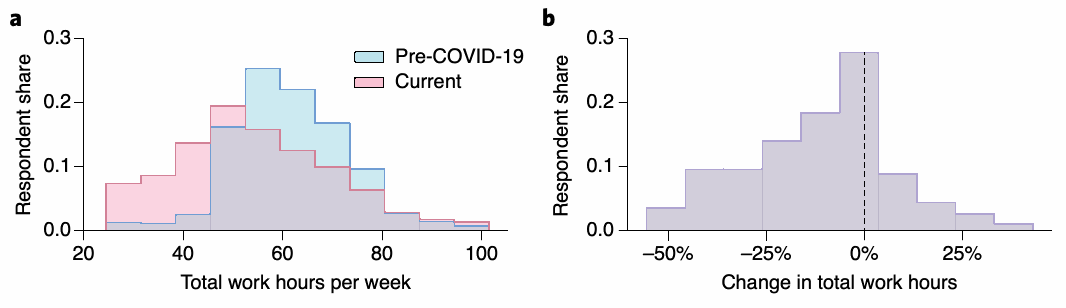
How to read this figure. Left: total weekly work hours before and during the pandemic. Right: changes in total work hours, with zero indicating no change. These charts cover all work; the reported decline in research time was larger. Source: Figure 1(a–b), p. 880, cropped from the paper. Click to enlarge.
What the survey captures
The survey was distributed on April 13, 2020 and collected responses over one week. Respondents reported work hours, task allocations, field, career stage, and household circumstances. They recalled their pre-pandemic work patterns.
Why circumstances matter
Research requiring physical laboratories fell more sharply. Having a young child was strongly related to reduced research time even after accounting for other measured characteristics. Reopening a lab alone may therefore leave some constraints unresolved.
This is an early snapshot from a self-selected sample. The response rate was about 1.6%. The results describe respondents’ reported experiences; they do not establish population-wide effects, the impact of a particular restriction, or long-term career outcomes.
Source: article published July 15, 2020, pp. 880–883 and Figures 1–2. Findings concern April 2020, rather than the pandemic as a whole. Full paper.
Questions about the paper
Which differences the survey reveals, what could explain them, and how they bear on institutional responses.
Can we treat the reported average decline as the effect on all scientists?
No. Only about 1.6% of contacted scientists responded, and people with particular experiences may have been more likely to take part. Respondents were mainly academic faculty and principal investigators in the U.S. and Europe. The 24% decline is informative about this sample, but cannot by itself establish the average effect across the scientific workforce. See Taking action, pp. 881–882.
Could field differences account for the gender and childcare differences?
Field explains some variation, especially in laboratory-based sciences. The analysis also examines individual circumstances alongside field and other measured characteristics. Gender and young dependents remain important predictors of reduced research time. That makes field composition an incomplete explanation, but does not rule out unmeasured circumstances or differences in how respondents reported their time. See Digging deeper and Figure 2, p. 881.
Does the childcare result identify the effect of closing schools or childcare facilities?
It shows that scientists with young children reported larger research-time declines, including after accounting for other measured characteristics. The survey does not randomly vary childcare access or separately identify a particular closure policy. The finding supports taking household responsibilities seriously when assessing constraints; it does not provide a causal estimate of a childcare intervention. See Digging deeper, p. 881.
Does a loss of research hours imply a proportional loss of scientific output?
The paper does not establish that relationship. It measures reported time during the first weeks of the pandemic, rather than completed discoveries or later publications. Researchers may change tasks, defer work, or recover some activity later. The reported hours show differences in the ability to conduct research; estimating output and career effects requires additional data. See Varied effects and Taking action, pp. 880–882.
Do the findings argue against uniform tenure-clock extensions?
They give a reason to examine whether uniform support addresses unequal losses of research time. The paper documents that many identified extension policies applied broadly, but does not estimate their effects. It therefore cannot establish that a uniform extension helps or harms a particular group, or identify the best alternative. Any evaluation should consider household circumstances alongside field and career stage. See Taking action, p. 882.
What does this imply for reopening and research support?
Access to laboratories and access to time are separate constraints. Reopening facilities may help laboratory-based research while leaving care responsibilities unresolved. The findings support checking both when designing support. They do not rank childcare provision, flexible deadlines, funding, or other measures by effectiveness or cost. The survey also cannot tell us how those needs evolved after April 2020. See Taking action, p. 882.