Scientific Talent Leaks Out of Funding Gaps
AI-generated summary. The summary and Q&A on this page were generated by AI, with limited human editing. Please refer to the paper for the full results and interpretation.
The paper in brief
Research funding delays can alter career trajectories.
A grant can be renewed and still leave a lab with a gap in funding. We study what happens to the people working in those labs. In labs with one NIH R01 research grant, funding gaps reduce the likelihood of working in the U.S. The effects are larger for graduate students and postdocs. We find no clear employment effects in labs with multiple R01s.
+3 percentage points
About three additional people per 100 in labs with one R01 are not working in the U.S.
+6.1 percentage points
Estimated increase for graduate students and postdocs in those labs.
Through year 5
The estimated increase remains positive through the fifth year after grant expiry.
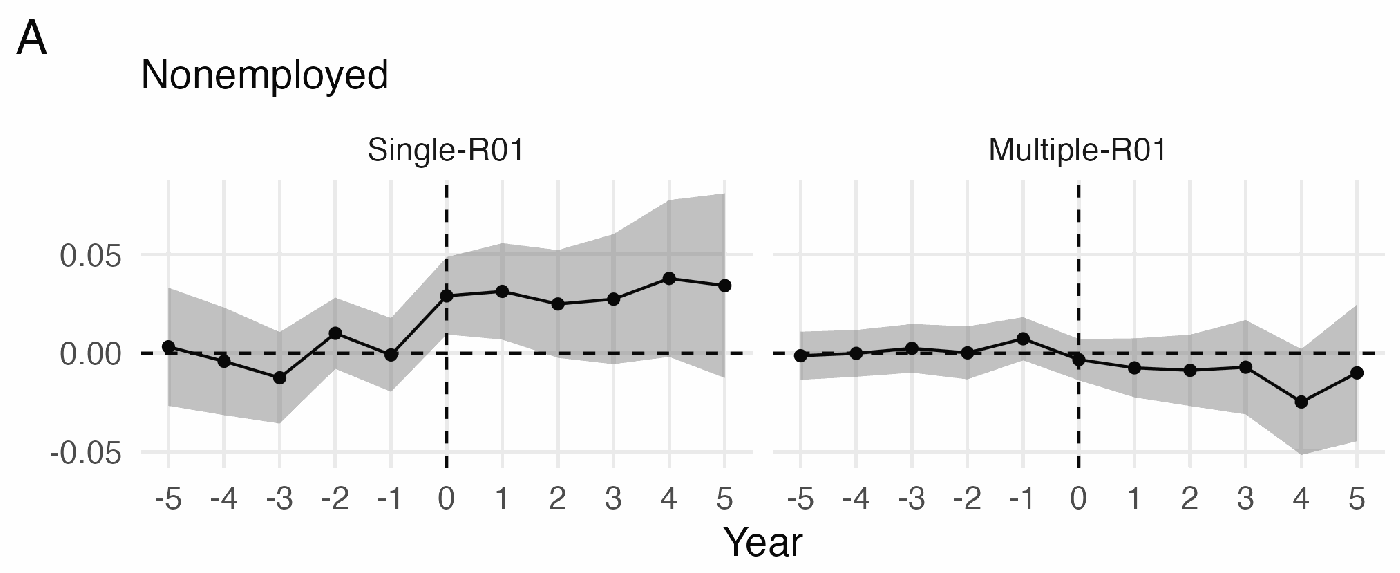
How to read this figure. Zero on the horizontal axis is the year the grant expires. The vertical axis measures the estimated change in probability: 0.03 means 3 percentage points. The shaded bands show uncertainty. Source: Figure 4A, p. 27, cropped from the paper. Click the figure to enlarge it.
What we compare
All the grants we study were eventually renewed. We compare changes in employment in labs with a funding gap of more than 30 days to changes in labs without such a gap. We link university payroll records to U.S. tax and earnings records covering 2005–2018.
Labs with multiple grants
Other grants may let a lab keep paying its personnel while it waits for a renewal. The absence of clear employment effects in labs with multiple R01s supports this explanation. The study does not test a bridge-funding program or measure whether its benefits would exceed its costs.
Some people move abroad. Not appearing in U.S. earnings records does not necessarily mean someone is unemployed. Evidence from the Census suggests that about half of the increase in people not working in the U.S. reflects departures from the country. The study concerns renewal delays; it does not estimate the effects of permanent grant cancellations.
Source: February 12, 2024 draft, Sections 3–5 and Table 3. The numerical findings on this page refer to that version. Full paper · Policy discussion.
Questions about the paper
What the comparison tells us, what happens to researchers, and what the findings imply for funding policy.
Could delayed renewals simply identify weaker labs?
That is a concern. All grants in the comparison were eventually renewed, and personnel in the two groups had similar employment trends before grant expiry. The results also hold when accounting for how many times a renewal application was resubmitted. These checks support the comparison, but delays were not randomly assigned. To interpret the estimates as effects of delays, we must assume that employment in the two groups would otherwise have followed similar trends. See Section 4, pp. 22–25.
Who is affected, and why don’t other funds cover the gap?
Graduate students and postdocs in labs with one R01 have the largest estimated employment effects. There is no clear employment effect for faculty or for personnel in labs with multiple R01s. Interviews with lab heads suggest that other grants can cover salaries, while university bridge funding may be too limited to do so. Having one R01 does not mean a lab has no other funding. See Section 2.3, pp. 12–13 and Table 3, p. 31.
Are people moving abroad, leaving research, or finding other U.S. jobs?
The results show several responses. People leave U.S. universities earlier, and the increase in not working in the U.S. continues through year five. Census evidence suggests that about half of this increase reflects moves abroad. Most of the increase also occurs among people without a PubMed publication in that year, suggesting less participation in research. PubMed includes work done abroad, but it does not capture all research activity. See Sections 5.1–5.3, pp. 26–38.
How should we interpret the earnings losses?
In labs with one R01, personnel with positive U.S. earnings in every year from one year before grant expiry through five years after earn about 20% less following a gap than they otherwise would have. This estimate covers everyone meeting that earnings condition, including people who stay in their lab. Restricting the sample to people who keep earning in the U.S. can affect the comparison. The data do not include earnings abroad. See Section 5.4.1, pp. 38–42.
Does this establish a case for bridge funding?
The study identifies a possible benefit: helping labs keep personnel employed during a gap. The contrast with labs holding multiple R01s supports the idea that access to other funds matters. It does not tell us how much a bridge-funding program would cost, who should qualify, or how many departures it would prevent. The findings alone do not establish whether a particular program would be worth its cost. The policy brief discusses possible funding responses.
Can these estimates tell us what happens after grant cuts or cancellations?
The estimates apply to temporary gaps in NIH R01 grants that were eventually renewed. A permanent cancellation changes both the amount of funding and expectations about future support. A broad cut could also reduce job options in other labs. This study does not measure those effects, so its estimates should not be used as forecasts for cuts or cancellations. See Section 2.1, pp. 9–10.