Money, Time, and Grant Design
AI-generated summary. The summary and Q&A on this page were generated by AI, with limited human editing. Please refer to the paper for the full results and interpretation.
The paper in brief
Grant design can shape who seeks funding and how they plan to use it.
Larger and longer grants may attract different researchers, as well as change the plans of those who receive them. Survey experiments find that researchers generally place more value on grant size than duration. Changes in design have relatively small effects on intended research strategies, while preferences differ substantially across researchers.
4,175 researchers
Research-active professors from major U.S. institutions in the main survey sample.
10% more funding
Valued about as much as 33% more duration in the main average-preference estimate.
1–2 percentage points
Typical changes in strategy choices for grant-design changes of 15–30%.
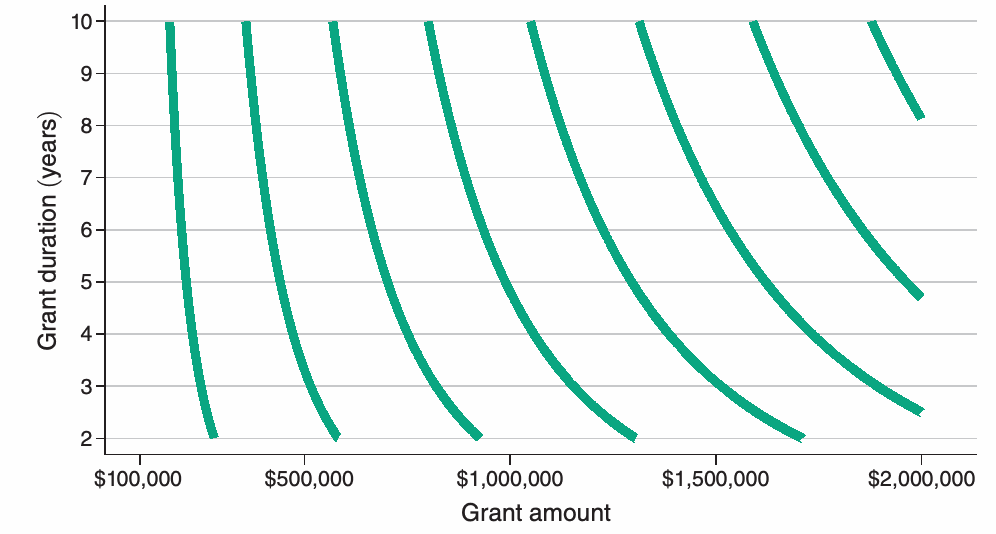
How to read this figure. Each curve joins grant amounts and durations that are equally attractive under the average-preference estimate. Moving toward a smaller grant requires a longer duration to compensate. Source: Figure 2, p. 362 / PDF p. 15, cropped from the paper. Click to enlarge.
What the experiments vary
One exercise asks how much funding researchers would give up for a longer grant. Another randomly varies a hypothetical grant’s size and duration and asks which changes to research strategy it would enable. The outcomes are stated preferences and plans.
What funders can learn
Changing grant terms may change the mix of applicants more than the strategies of a given recipient. Differences in outcomes across grant programs could therefore reflect whom they attract, alongside what their grants enable recipients to do.
No actual grants were randomized. The experiments identify responses to hypothetical offers. They do not establish how changing a real program would affect applications, completed research, or the social value of discoveries.
Source: published October 2026 article, pp. 348–379, especially Sections III–IV and Tables 3–5. The 33% duration comparison uses the main Table 3 estimate. Full paper.
Questions about the paper
What grant preferences tell us, how to interpret small strategy responses, and what the results imply for program design.
Does this show that longer grants do little for research?
It shows relatively small changes in reported strategies when the duration of a hypothetical grant changes. It does not measure all benefits of longer grants, such as fewer applications, more stable employment, or better project completion. Longer grants are attractive to some researchers, and tenured professors report more willingness to pursue riskier work with longer grants. See Section IV, PDF pp. 19–25.
Why does the distinction between attracting researchers and changing their behavior matter?
A program may fund riskier research because it attracts researchers who already pursue risky work. It could also encourage its recipients to take more risks. These mechanisms imply different results if the applicant pool changes or the program expands. The survey separates preferences over grants from intended responses to receiving one, helping funders think about both channels. See Introduction, PDF pp. 2–4.
Who places more weight on money than duration?
The preference for money is stronger among researchers whose work uses more funding per research hour, who expect greater access to other funding, who are less risk averse, and whose salaries depend more on grants. The paper also finds differences consistent with discounting future benefits. These are relationships between characteristics and preferences; they do not show that changing those characteristics would change preferences. See Section III.D, PDF pp. 15–18.
How much should we trust answers about hypothetical grants?
The offers have randomized attributes, so differences in answers can be attributed to the offers within the survey. The paper checks survey attention, compares reported salaries with public records, and examines nonresponse using randomized recruitment incentives. These checks support the responses, but real applications and research decisions could differ when money is at stake. See Section II, PDF pp. 8–11.
Should funders therefore make grants larger and shorter?
Researchers’ preferences do not determine the socially best grant design. A funder must also consider which projects it wants to support, how many researchers it can fund, and the value of different research strategies. The findings show that trading size for duration can change who finds a grant attractive. They do not identify one design that maximizes research value. See Sections III–IV, PDF pp. 12–25.
What would a useful test in a real funding program measure?
It would track both the applicant pool and the outcomes of recipients. Comparing recipients alone could miss changes in who applies or accepts an award. A program evaluation would also need realized measures of research and costs, since this paper measures preferences and intended strategies. The findings help specify those distinctions; they do not supply the results of such an evaluation. See Conclusion, PDF pp. 28–29.