Science, Interrupted: Funding Delays Reduce Research Activity but Having More Grants Helps
AI-generated summary. The summary and Q&A on this page were generated by AI, with limited human editing. Please refer to the paper for the full results and interpretation.
The paper in brief
Funding delays can change lab spending even when grants are eventually renewed.
NIH grants sometimes expire before renewed funding becomes available. In labs with one R01, these gaps are associated with sharp reductions in spending, much of it on personnel. Labs with multiple R01s maintain more stable spending, consistent with using other grants to cover the gap. The study follows monthly spending and grant-funded employment.
52% less spending
In single-R01 labs over the 16-month window from three months before expiry through month 12.
96% at the low point
Estimated spending reduction in single-R01 labs relative to uninterrupted labs.
About 9 months
After expiry for monthly total spending to catch up with uninterrupted labs.
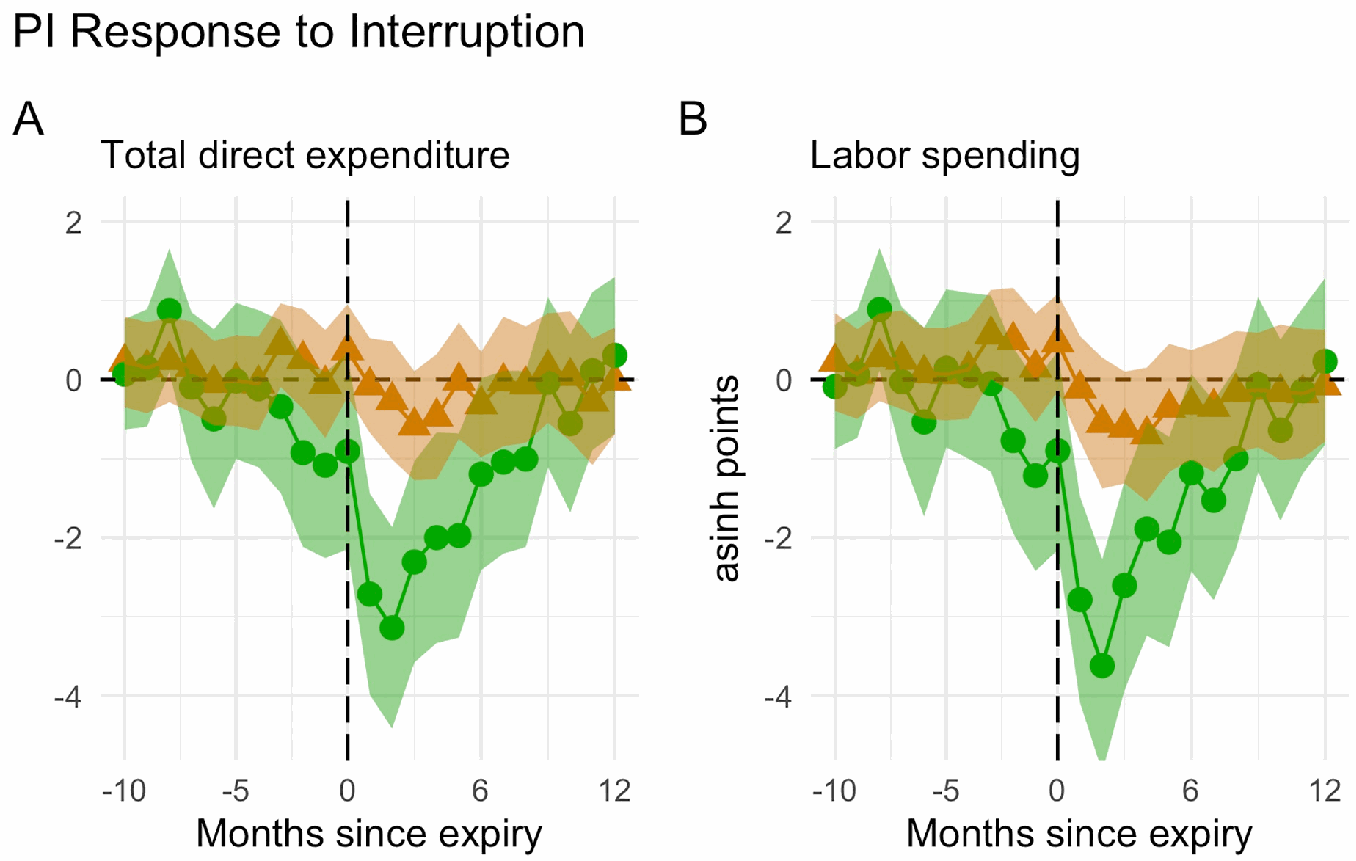
How to read this figure. Green circles are labs with one R01; orange triangles are labs with multiple R01s. Zero on the horizontal axis is grant expiry. The vertical axes use a transformation similar to logs, rather than percentages. Shading shows 95% confidence intervals. Source: Figure 3(A–B), p. 12, cropped from the paper. Click to enlarge.
What the study compares
All focal grants were eventually renewed. The analysis compares changes around expiry for renewals delayed by more than 30 days and renewals without such a delay. University transaction records show monthly payments to workers and vendors.
Why other grants matter
Spending is more stable when a lab has several R01s. Employee records also show that people connected to multiple grants are less likely to stop receiving grant payments. These patterns support the view that other grants can provide temporary funding.
Spending and research output are different outcomes. The paper finds clear spending changes, but its publication estimates are too imprecise to establish an effect on output. It also does not observe all internal university funding.
Source: published April 26, 2023 article, Introduction, Results, and Figure 3. Spending percentages refer to labs with one R01 and depend on the time window; they are not estimates of lost scientific output. Full paper.
Questions about the paper
What spending changes reveal, how other grants help, and what the estimates do not establish.
Could interrupted labs have been on a different path even without a delay?
Delays are not random, so this is a concern. The analysis compares grants that were all renewed, matches projects on their previous duration, and checks trends around expiry. Agencies may still prioritize labs differently, and unobserved differences could affect outcomes. The comparison relies on interrupted and uninterrupted labs otherwise following similar trends. See the paper’s Empirical strategy and Descriptive statistics sections.
Does 52% less spending mean half the research was lost?
No. The 52% describes spending over a particular 16-month window. It does not measure lost discoveries or establish how much spending was permanently forgone rather than shifted in time. The publication estimates are too imprecise to settle the output question. Monthly transaction data show changes in research inputs that publications alone may miss. See Results and Figure 3.
Do lower grant payments mean that employees lost their jobs?
Not necessarily. A person may stop being paid from a lab’s grants but continue working with support from another grant, teaching, or internal university funds. Employee-level analyses check whether people receive payments from the same investigator and from any recorded grant. They still do not provide a complete record of employment or later careers. See Employee-level analyses.
Are these liquidity constraints or uncertainty about future funding?
The paper does not separate them. Labs can lack cash to cover current expenses and also be unsure whether or when renewed funding will arrive. Either could affect spending and commitments to personnel. The relative stability of labs with multiple grants is consistent with a funding buffer helping, but does not isolate the contribution of cash versus certainty. See the Introduction and conceptual framework.
Should agencies give each lab several grants to insure against delays?
The results show that other grants can cushion interruptions. They do not compare the costs and benefits of concentrating grants in fewer labs against alternatives such as bridge funding or faster renewals. Supporting more labs could have benefits that this comparison does not measure. A policy choice needs evidence about both continuity and the allocation of funding across researchers. See the paper’s Introduction.
What does the study imply for the timing of agency decisions?
Waiting to award funds may help an agency compare proposals or respond to an uncertain budget. The results identify a cost that belongs in that decision: ongoing labs reduce spending and grant-funded personnel payments while waiting. The paper does not calculate the optimal decision date or compare this cost with the gains from waiting. It provides evidence on one part of that trade-off. See the paper’s Introduction and NIH funding discussion.